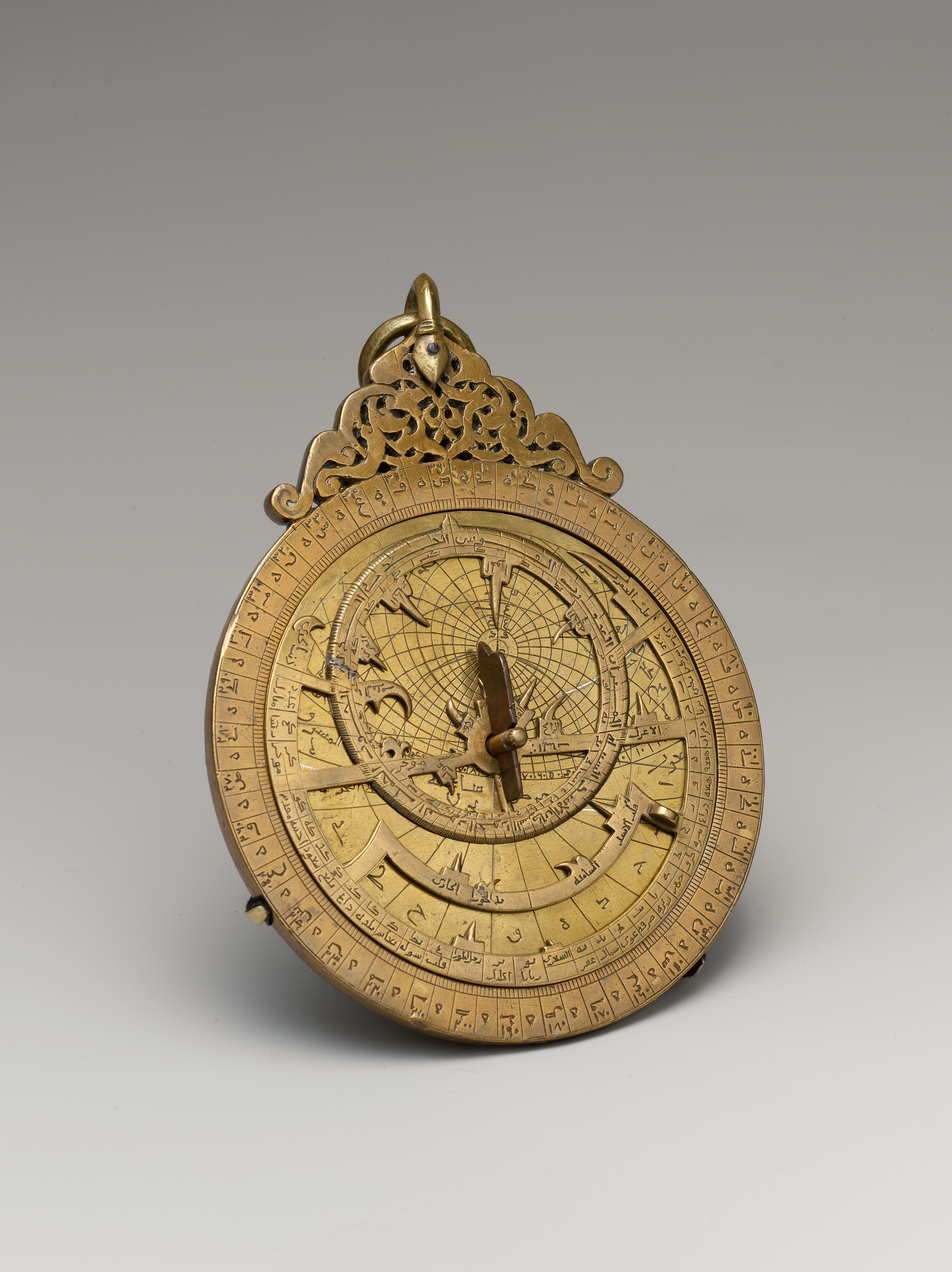
Yemen, 1291
The record describes brass, piercing, chasing and silver inlay; case diameter 15.6 cm; The Met 91.1.535a-h.
Read object record →Two dated brass instruments share a broad form but have different recorded production places, dates, components and measurement fields. The comparison keeps those records separate from claims about travel or use.
Reviewed 9 October 2026 · Institution records and image status accessed 8 October 2026
The record describes brass, piercing, chasing and silver inlay; case diameter 15.6 cm; The Met 91.1.535a-h.
Read object record →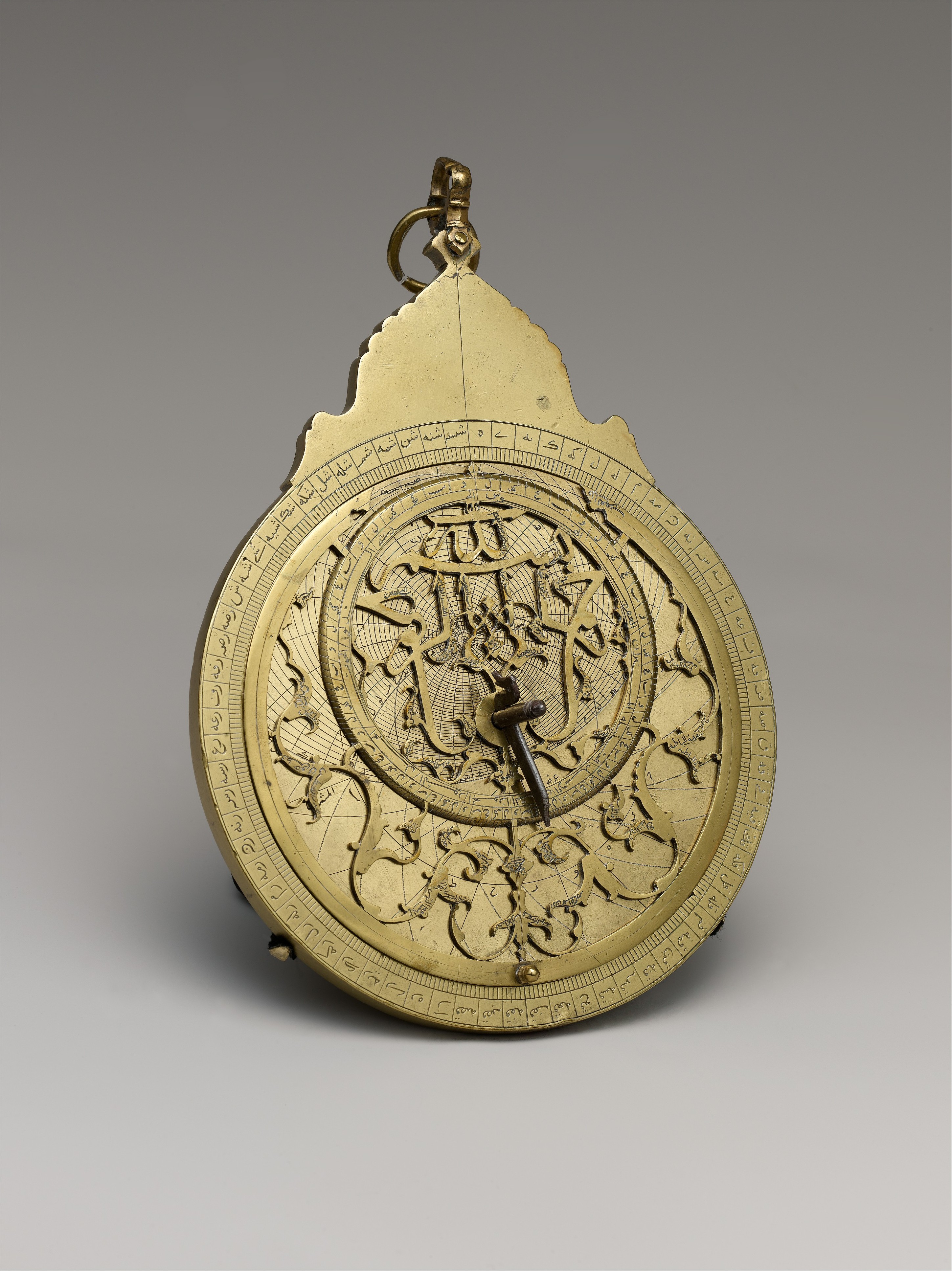
The record describes brass and steel, piercing and engraving; overall height 21.6 cm; The Met 63.166a-j.
Read object record →Both institution records provide a title, production place, date, material or process description, component information and dimensions. Those matched field types support a close-reading exercise. The category does not make two objects representative of all Islamic-world astrolabes.
The 1291 record explicitly lists a case, bar, net, four plates and pin. The 1654-55 accession spans parts a-j and is documented through multiple views. Component counts can be compared as catalogue facts. Determining the latitude markings, completeness, operating sequence or historical user requires inscriptions and specialist cataloguing beyond this page.
The earlier record says chased and silver-inlaid; the later record says pierced and engraved and lists brass and steel. Photograph color cannot independently verify alloy, corrosion state or inlay. Technical conclusions require examination or conservation analysis.
The Yemeni object publishes a case diameter of 15.6 cm, while the Mashhad object publishes overall height, width and depth. Those fields describe different extents. A statement that one is simply “larger” would require the same measurement definition for both.
The selected records do not by themselves reconstruct each instrument's travel, frequency of use, named operators or every repair. A production-place label is not a complete ownership or movement history.
Two dated brass instruments share a broad form but have different recorded production places, dates, components and measurement fields.
| Observe | Describe material, form, marks, wear or spatial relation without assigning identity or purpose. Begin with “Yemen, 1291.” |
|---|---|
| Context | Locate the record in excavation, collection, restoration and display history. Check the chain against The Metropolitan Museum of Art, object 444408 and The Metropolitan Museum of Art, object 451699. |
| Infer | Read inscriptions, scale geometry, alloy, workshop practice and latitude-related design together, while keeping later ownership separate from original use. Tie every attribution to the feature that supports it and retain competing readings. |
| Withhold | Do not extend “Mashhad, 1654-55” beyond the date, sample, comparison or provenance actually documented. |
List each custody or documentation gap separately; an unknown interval is evidence about the record, not permission to invent continuity.
Reviewed 9 October 2026 · Institution records and image status accessed 8 October 2026 Mark later repairs, labels and digital reconstructions as later interventions rather than original features.
Research-room promptWhat single comparison object, technical test or archive entry would most change the interpretation of How do two astrolabes carry place?